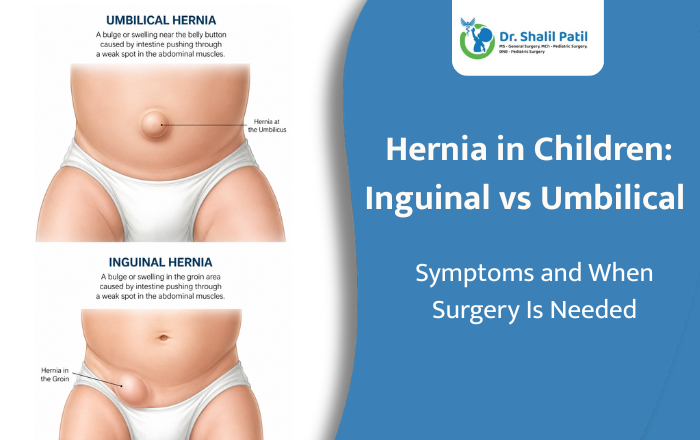
A hernia in a child occurs when an internal tissue or part of the intestine pushes through a weak area in the abdominal wall. Parents may notice a small swelling or bulge, especially when the child cries, coughs, strains or stands. The two common types are inguinal hernia and umbilical hernia, and they are managed differently depending on the child’s age, symptoms and the type of hernia.
If you are looking for information about hernia in children, understanding the difference between these two types can help you know when observation may be reasonable and when a pediatric surgeon should assess the child.
What Is a Hernia in Children?
A hernia develops when tissue from inside the abdomen pushes through an opening or weak area in the abdominal wall. In children, many hernias are related to openings that were present during development before birth but did not close completely.
The swelling may appear and disappear. It can become more noticeable when a child cries, coughs, passes stool or performs activities that increase pressure inside the abdomen.
The two types parents most commonly encounter are:
- Inguinal hernia: Appears in the groin and may extend toward the scrotum in boys or the labia in girls.
- Umbilical hernia: Appears around the belly button.
Although both are hernias, their natural course and treatment are not the same.
Inguinal vs Umbilical Hernia in Children
Inguinal Hernia
An inguinal hernia occurs when abdominal tissue passes through the inguinal canal, a passage in the lower abdominal wall. In boys, the swelling can sometimes extend into the scrotum.
A typical sign is a soft bulge in the groin that may become more visible when the child cries or strains and may disappear when the child relaxes or lies down.
Inguinal hernias in children generally do not close on their own and are usually treated surgically after evaluation by a pediatric surgeon.
Umbilical Hernia
An umbilical hernia develops at the belly button, where the abdominal wall had an opening for the umbilical cord before birth.
It usually appears as a rounded swelling around the navel. Many small umbilical hernias cause no pain and become less noticeable when the child is relaxed.
Many umbilical hernias close naturally during early childhood, so observation may be recommended in suitable cases. The decision depends on factors such as the child’s age, the size of the opening and whether symptoms are present.
Symptoms of Hernia in Children
The symptoms can vary depending on the type and whether the hernia is causing a complication.
Common signs include:
- A visible swelling in the groin or around the belly button
- A bulge that becomes more noticeable during crying, coughing or straining
- A swelling that reduces or disappears when the child is relaxed or lying down
- Groin swelling that may extend into the scrotum in boys
- Discomfort or pain around the swelling in some children
A swelling does not always mean that a child has a hernia. Other conditions can cause lumps in the groin or abdominal area, so a proper examination is needed for diagnosis.
When Does a Child With a Hernia Need Surgery?
The need for surgery depends mainly on the type of hernia, the child’s symptoms and the risk of complications.
For an inguinal hernia, surgery is commonly recommended because the opening usually does not close by itself and there is a risk that abdominal tissue or intestine can become trapped.
For an umbilical hernia, surgery may not be immediately necessary if the child is young, the hernia is small and there are no concerning symptoms. The pediatric surgeon may recommend monitoring it for a period of time.
Surgery may be considered for an umbilical hernia when it persists beyond the expected period of natural closure, is unusually large, causes symptoms, or has other clinical concerns.
The exact timing should be decided after examining the child.
When Should You Consult a Pediatric Surgeon?
Parents should arrange a medical evaluation if they notice a new or persistent swelling in the groin, scrotum or around the belly button.
Seek urgent medical attention if the swelling:
- Becomes painful or very tender
- Becomes firm and does not reduce
- Turns red, purple or develops a significant change in colour
- Is associated with repeated vomiting
- Occurs with severe abdominal pain
- Is accompanied by marked irritability or the child appears unusually unwell
These symptoms can indicate that the hernia is trapped or that its blood supply may be affected. Such situations require prompt medical assessment.
How Is Hernia in Children Diagnosed?
A pediatric surgeon can often diagnose a hernia through the child’s medical history and physical examination. The doctor may examine the swelling while the child is standing, crying or straining, depending on the child’s age and cooperation.
An ultrasound or other imaging test is not always necessary. It may be advised when the diagnosis is unclear or when another condition needs to be considered.
Treatment decisions are based on the type of hernia, its size, symptoms, the child’s age and overall health.
How Is Hernia in Children Treated?
Treatment depends on the type of hernia.
- Inguinal hernia: Surgical repair is generally recommended because spontaneous closure is unlikely. The surgeon closes the abnormal opening so that abdominal contents can no longer protrude through it.
- Umbilical hernia: Observation is often appropriate for children with a small, uncomplicated hernia that is expected to close naturally. Surgery may be recommended if the hernia persists, becomes symptomatic or has other features that warrant repair.
Parents should not try to push a painful or firm swelling back into place. If a hernia becomes painful, stuck or changes colour, medical assessment should be sought promptly.
Frequently Asked Questions
1. Can an inguinal hernia in a child go away on its own?
Usually, no. Inguinal hernias in children generally do not close spontaneously, which is why surgical evaluation is commonly recommended.
2. Does an umbilical hernia always require surgery?
No. Many childhood umbilical hernias close naturally as the child grows. Observation may be appropriate when the hernia is uncomplicated, but the child should be assessed by a healthcare professional.
3. Is a hernia painful for children?
Not necessarily. Many hernias are painless and may only appear as a swelling. Pain, tenderness, a firm swelling or a bulge that cannot be reduced requires prompt medical assessment.
Have questions? We’re just a message away! Contact us on WhatsApp — Click Here to Chat with Us
Concerned About Your Child’s Hernia? Consult a Pediatric Surgeon
Hernia in children can present differently depending on whether it is inguinal or umbilical. Inguinal hernias generally require surgical repair, while many umbilical hernias can be observed because they may close naturally during childhood.
If your child has a swelling around the groin or belly button, do not assume that surgery is immediately required or that the swelling will definitely disappear on its own. A pediatric surgeon can determine the type of hernia and advise whether observation or treatment is appropriate.
If you are concerned about a possible hernia in your child, Dr. Shalil Patil, Pediatric Surgeon with 12+ years of experience, provides consultation for pediatric surgical concerns in Vasai and Virar. A clinical assessment can help determine the cause of the swelling and the appropriate next step for your child.
Name – Dr. Shalil Patil – Pediatric Surgeon in Virar | Pediatric Urologist | Hypospadias Surgeon in Virar
Address: OPD No. 3, Yashwant vihar complex, Sahyog Hospital, behind MHADA ground, Bolinj, Virar West, Vasai-Virar, Maharashtra 401303
Phone: 87671 43931